
First, the disclosure: we make one of the apps on this list. Snap & Store is ours. The way we've kept this comparison honest is simple — every fact below comes from the apps' own store listings and published pricing, and for each app we say who it genuinely fits, including when that isn't us.
The second thing worth saying: the most popular home inventory tool in 2026 is still a spreadsheet, and the reason people abandon spreadsheets and apps alike is the same. Typing every item is the real cost, and almost nobody pays it twice. Keep that lens as you compare: the question isn't which app has the most fields, it's which one you'll still be using in March.
The short version
| App | Pricing | Best for | The catch |
|---|---|---|---|
| Snap & Store | 3 boxes free forever · $3.99/mo | Boxes, bins, storage units — finding things again | Retrieval-first: no valuation/warranty fields |
| SnapFind | $9.99/mo | Camera-first cataloging, if cloud storage doesn't bother you | Cloud AI: your photos upload; account required |
| Sortly | Free cap (100 items, 1 user) · ~$49/mo | Small business and warehouse inventory | Priced and built for business, not a garage |
| Boxes | Free | Careful manual catalogers | You type every item yourself |
| Smart Labels | Label packs + free app | People who want physical QR labels at retail | The app scans; the typing is still yours |
| Under My Roof / Home Contents | ~$4.99/mo · ~$5.99 one-time | Insurance documentation: values, receipts, serials | Form-first; heavy data entry per item |
| The spreadsheet | Free | Nobody, long-term | It IS the typing problem |
The capture-first apps
Snap & Store (ours). Stick a QR label on a box, snap a quick video of what's going in, and on-device AI writes the contents list — then you search "ski gloves" and it answers with the box and where it lives. The design bet is that a home inventory only survives if adding a box costs seconds, not minutes. Photos, video, and audio never leave your phone: no account, works offline, which also means it works in a storage unit with no signal. It is deliberately not an insurance tool — there are no valuation or warranty fields. Your first 3 boxes are free, forever; Unlimited is $3.99/mo. How it works.
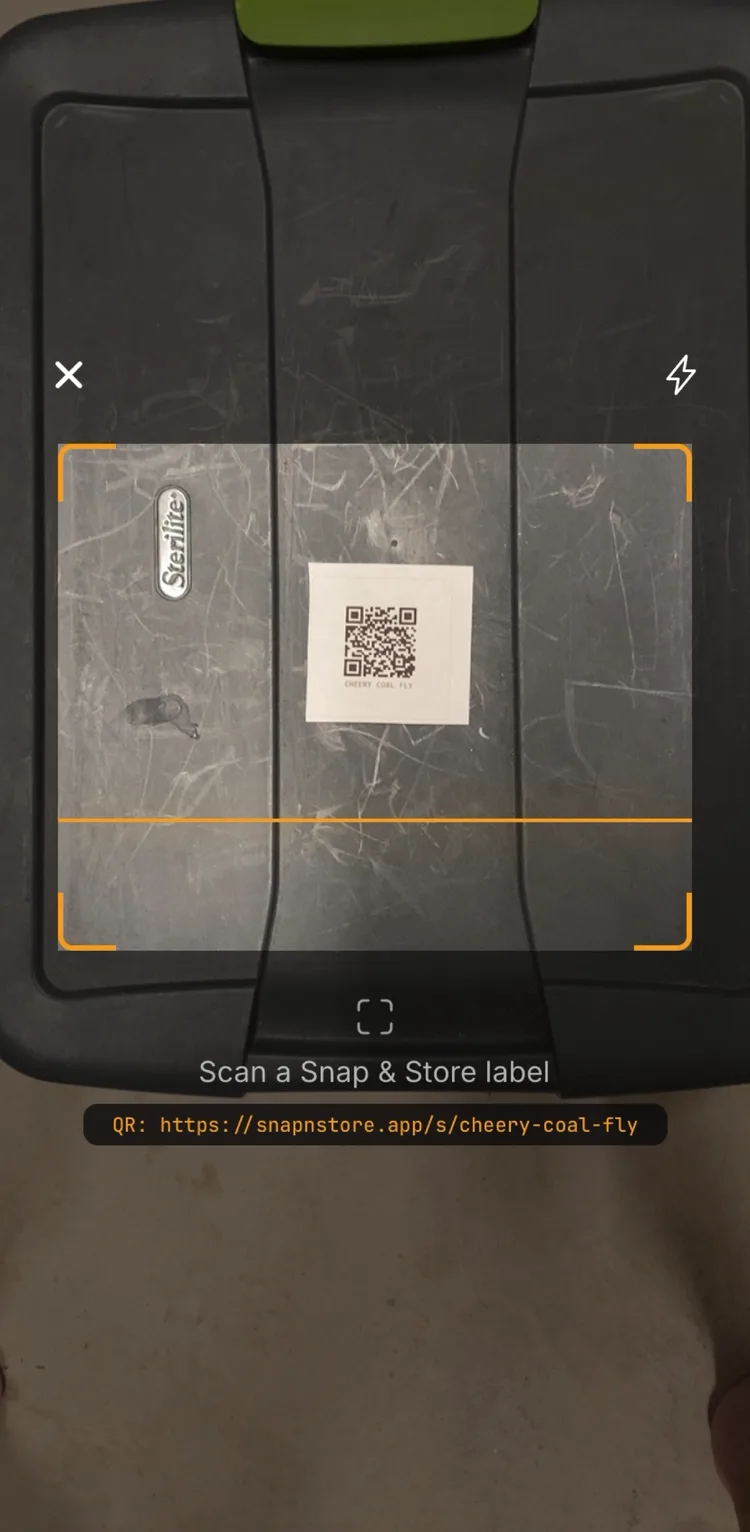 Scan any box's label and see inside without cutting tape.
SnapFind makes the same capture-not-type promise with a different architecture: your photos upload to their cloud, where the AI does its work. That buys them some conveniences, and it costs you an account, a connection, and a copy of your belongings on someone else's server — at $9.99/mo, two and a half times our price. If cloud storage doesn't bother you, it's a credible app. If it does, that's the fork in the road between us.
The manual catalogers
Boxes has been the shelf's steady manual tracker for years, and its users clearly love the control. Every item is typed by hand, which is exactly the workflow that kills most inventories — but if you're the person who enjoys the cataloging itself, it's free and it's disciplined.
Smart Labels sells what's genuinely a nice product: durable QR label packs you can buy at retail, with a free companion app. Scan a label, then type or caption the contents yourself. It's a labeling system more than an inventory system — the list still comes from your thumbs.
The specialists
Sortly owns business inventory, and earned it. But its consumer story has faded: the free tier caps at 100 items and one user, and paid plans run around $49 a month, warehouse pricing for a garage problem. If you landed here searching "Sortly alternative" for home use, the honest answer is that Sortly didn't get worse, it just stopped being for you.
Under My Roof and Home Contents are insurance-documentation apps: valuations, receipts, serial numbers, room-by-room forms. If your goal is a claim- ready ledger of your possessions, they're built for exactly that, at fair prices. If your goal is finding the ski gloves in November, form-first tools make you pay the data-entry cost up front, every item, forever.
How to actually choose
Ask one question: what do you want to be true in six months? If the answer is "a valuation ledger for my insurer," pick a form-first specialist. If it's "my business stockroom is tracked," that's Sortly. If it's "when I need something from a box, I know which box" — pick whichever capture-first app matches your comfort with the cloud. We built Snap & Store for people whose answer to that last question includes "and my stuff stays on my phone."
And if you're still tempted by the spreadsheet: we wrote up why home inventory apps fail, and the spreadsheet fails the same way, sooner.