
There's a specific graveyard on most phones: the home inventory app, downloaded in a burst of January resolve, holding nine carefully entered items and nothing else. Not because the app was bad. Because somewhere around item ten, a quiet accounting happened — this is 30 seconds of typing per object, I own several thousand objects — and the project ended.
If that's you, nothing went wrong with you. The math genuinely doesn't work. Here's the failure mechanism, and the way around it.
The typing is the product
Open a typical inventory app and add one item. Name. Category. Location. Maybe a photo, a quantity, a condition. Call it 30 seconds when you're fresh.
Now scale it. A garage of bins, a closet of boxes, the under-bed stuff: a modest home stash is 40 boxes, and a box holds 15 to 30 things. That's 10 to 20 hours of data entry — a part-time job you assigned yourself, unpaid, with dusty hands. The apps didn't advertise this because the demo always shows item one, never item four hundred.
So people rationally quit. And the half-finished inventory that remains is worse than none: it answers some searches wrongly, you stop trusting it, and now even the nine typed items are wasted.
The spreadsheet fails identically, just with worse ergonomics. The medium isn't the problem. The keyboard is.
What survival actually requires
Watch the systems that DO survive in the wild — the ones people still use a year in — and they share three traits:
Adding is nearly free. If putting a new box into the system costs more than a few seconds, the system stops growing the first busy week, and a system that stops growing is already dead.
The system tolerates mess. Real boxes are "kitchen stuff and also some cables and the dog's old leash." Any tool that demands one-category-per-item is asking you to lie or to reorganize your life for the tool's benefit.
Retrieval is the payoff, and it's instant. People don't want an inventory. They want the answer to one question, a few times a month: where is it? If getting that answer takes effort, the whole system's reason to exist evaporates.
Notice what's missing from that list: completeness, categories, valuation fields. The features inventories are sold on are not the features that keep them alive.
The capture-first way out
The escape from the typing math is to stop typing. Point a camera into the box instead: a few seconds of video, narrate if you like, close the box. A box that would take eight minutes to type takes seconds to snap — that's the difference between a system you finish and a system you abandon.
The catch, historically, was retrieval. A camera roll full of box photos is cheap to make and miserable to search. This is the gap Snap & Store was built to close: the AI catalogs what it sees in your capture, in the background, and your photos and video stay attached to the box so you can always look for yourself. When you need the rice cooker, you search "rice cooker" and get an answer — Box 7, garage — instead of a scavenger hunt. Here's the whole flow, and your first 3 boxes are free, forever.
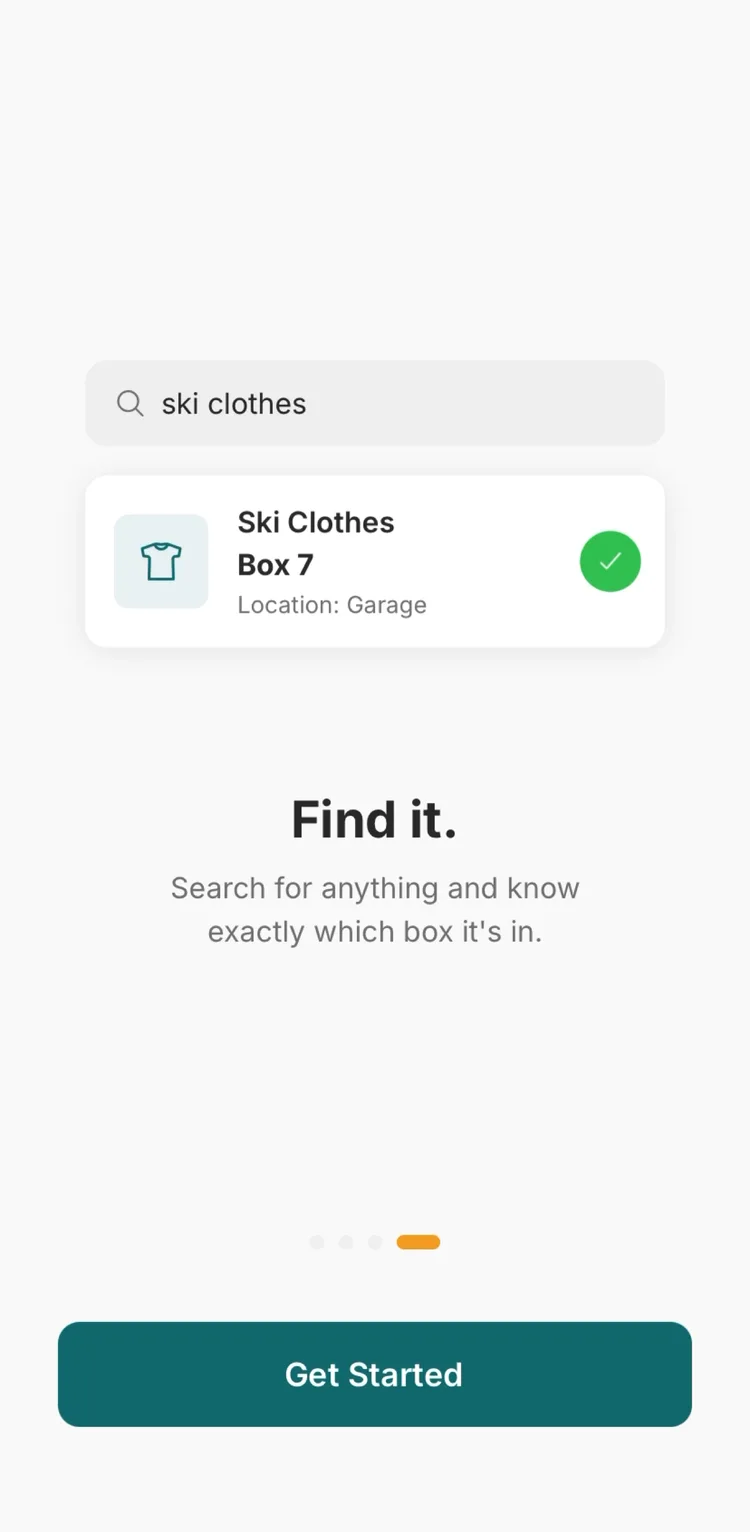 Retrieval is the whole point: search the item, get the box.
For the garage-and-closet stash specifically, one more property matters: the system has to work in bursts. Nobody inventories a garage in a sitting. A capture-first system lets you do four boxes on a random Tuesday and still be net ahead, because each box is done in under a minute and never needs revisiting.
If you've already failed at this twice
Good — you have data. You know exactly where your last system died: the typing, or the updating, or the retrieval that never paid off. Judge any new tool, ours included, against that specific failure. We compared the current field honestly, including where our approach isn't the right fit, in our comparison of this year's home inventory apps.
The stuff in the boxes hasn't gone anywhere. It's still findable. It's just waiting for a system that costs less than it pays.