
Most storage-organization advice optimizes for the wrong moment: the day you pack. Matching bins, color-coded lids, tidy stacks — the garage looks great in the after photo. Then February arrives, you need the tire chains, and the beautiful system offers you no better tool than opening boxes until you win.
Organizing for looks and organizing for retrieval are different projects. Retrieval is the one you'll actually use. Build backwards from the only question storage ever has to answer — "where is it?" — and the system gets simpler, not fancier.
Rule 1: Boxes get numbers, not descriptions
"Kitchen misc" is a lie waiting to happen — one repack and the label's wrong forever. A number is just an address, and addresses don't expire. Box 6 is Box 6 no matter what migrates into it.
Rule 2: The contents live somewhere searchable, not on the box
The Sharpie side-label can hold five words; the box holds fifty things. Keep the what somewhere that can be searched and updated without peeling anything. This is where most systems die — the notebook, the spreadsheet, the app with forms — because typing fifty things per box is a part-time job. (We've written about why that kills nearly every inventory attempt.)
The escape is capture instead of typing: before a box closes, snap a quick video of what's inside. With Snap & Store, that video is the data entry — the app catalogs the box's items from it, each item with its own photo, and the QR label you printed connects the physical box to its record.
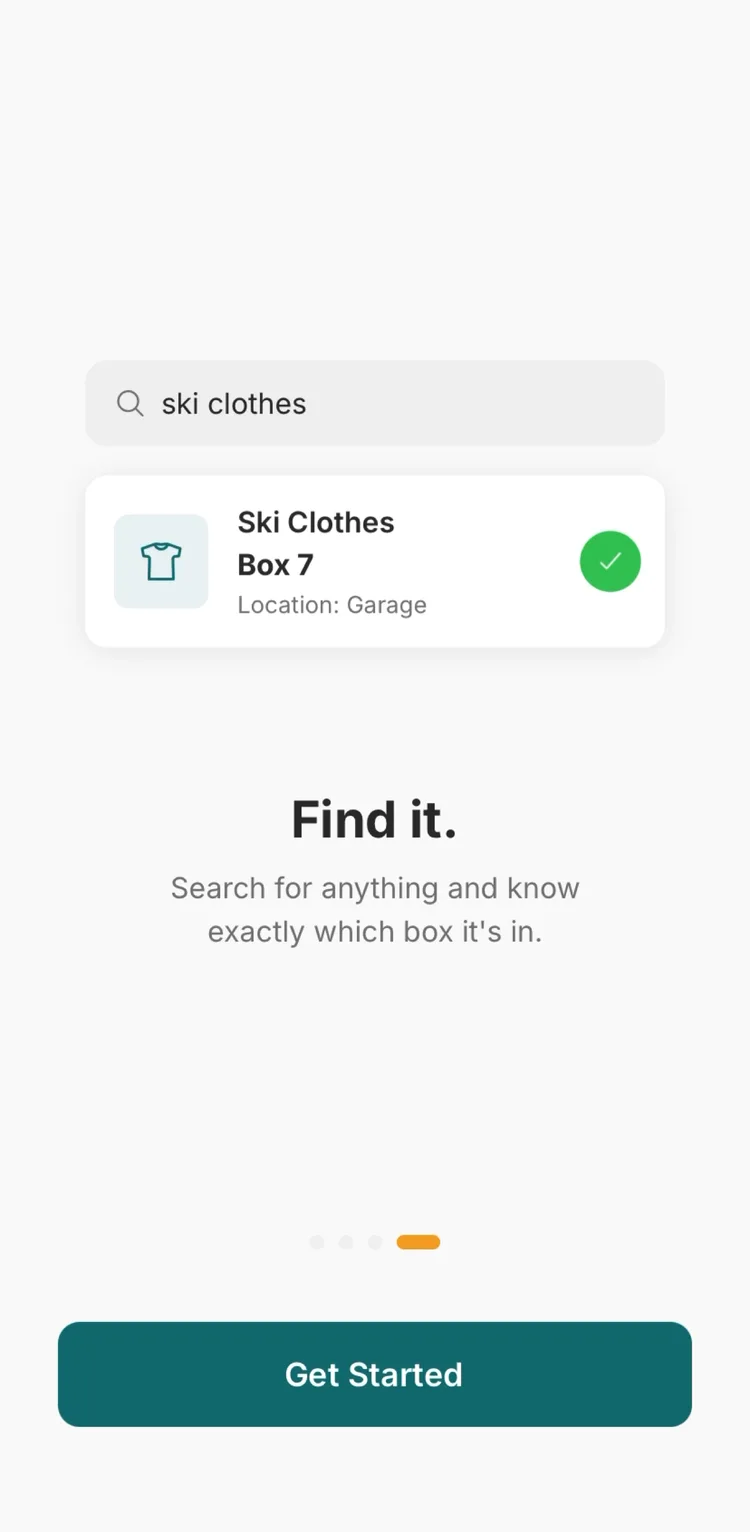 The payoff: search the item, get the box and where it lives.
Rule 3: Location is part of the address
"Box 6" is half an answer; "Box 6 · garage, left shelf" ends the search. Give every box a location the day it lands somewhere, and update it only when a box moves — which is rare, and takes seconds when it happens.
Rule 4: Never organize by dumping everything out
The classic weekend plan — empty the whole garage, sort into piles, reorganize — is why garages stay unorganized. It requires a free weekend, good weather, and morale. Retrieval-first systems work incrementally: every time you close any box for any reason, it enters the system. Four boxes on a Tuesday. The backlog shrinks without ever being a project.
What this looks like six months in
You need the fondue set. You search "fondue" and get the answer: Box 11, hall closet. You walk over, scan the label to double-check without opening it, and you're done in ninety seconds — including the walk. Nothing was dumped out, so nothing needs repacking, so the system never decays.
That's the whole difference: pretty systems decay every time you use them; retrieval systems don't get used up. Here's how the pieces work, and if your garage is the epicenter, start there — your first 3 boxes are free, forever.