
Every storage unit starts organized. You know where the winter clothes are, which box has the tax records, roughly where the camping gear ended up. Six months later the unit is a wall of identical cardboard, and the only way to answer "do we still have the crib?" is to drive over and start opening boxes.
Search for advice and you'll get the same answer everywhere: make a spreadsheet. Number your boxes, type every item into a row, keep it updated. It's the right instinct and the wrong tool. Here's why the spreadsheet fails, and what to do instead.
Why the spreadsheet never survives
The spreadsheet dies for one reason: it costs 20 to 30 minutes of typing per packing session, at exactly the moment you have the least patience for it. Packing a unit is sweaty, deadline-driven work. Nobody stops to type "misc. kitchen — ladle, trivets, the good scissors" into their phone with dusty hands.
So the last few boxes go in unlisted. Then a visit swaps some things around and the sheet doesn't hear about it. Within two trips the spreadsheet is wrong, and a wrong inventory is worse than none, because you stop trusting it and go back to opening boxes.
There's a second, quieter problem: a spreadsheet can't hold a photo. "Box 12 — cables" tells you almost nothing. A ten-second look inside the box tells you everything.
The system that actually works
Whatever tools you use, three rules do most of the work:
1. Number the boxes, describe nothing on them. Write "14" on the box, not "kitchen misc." Labels lie the second you repack a box. The number is just an address; keep the contents somewhere that's easy to update.
2. Capture, don't type. Before a box closes, snap a few seconds of video of what's inside. Narrate if it helps ("winter boots, the fondue set, grandma's tablecloth"). This is the step that replaces the spreadsheet, and it's fast enough that you'll actually do it for box 23, not just box 3.
3. Record location once per trip. "Boxes 1–9: back-left stack. 10–14: right wall, under the desk." One sentence per visit keeps the map current.
Do this with your camera roll and a notes app and you're already ahead of the spreadsheet. The remaining problem is retrieval: three months later, finding the fondue set means scrubbing through your camera roll hoping you captured it.
The shortcut: let the capture become the catalog
This retrieval problem is what Snap & Store exists for. The workflow is the system above, minus the bookkeeping:
- Stick a Snap & Store label on the box and scan it — the box gets its number and a location field ("Box 14 · Unit 210").
- Snap a quick video of what's going in and narrate if you want. The AI catalogs what it sees in the background, and your photos and video stay attached to the box, so you can always look for yourself.
- Later, search "fondue" from your couch. The app answers with the box and its location, no driving required.
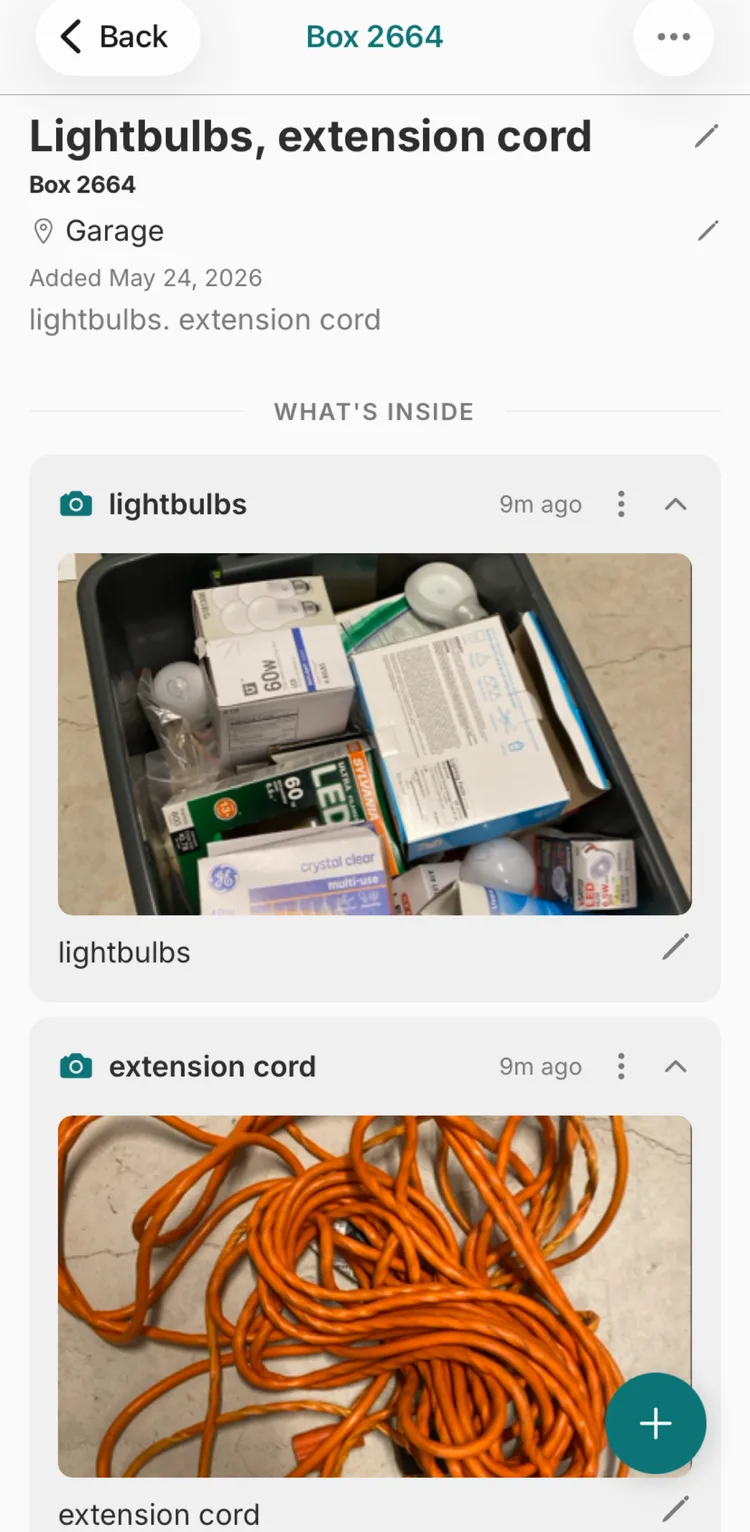 The box detail screen — every capture becomes a searchable contents list.
Two details matter specifically for storage units. Everything runs on your phone, so it works inside a concrete building with no signal — no account, no signal, no cloud copy of your stuff. And because the inventory lives on your device rather than a server, it can't be discontinued out from under you.
Your first 3 boxes are free, forever — on iOS and Android.
A note on insurance
An honest inventory has a second job you hope never comes up. If a unit is broken into or damaged, the claim process starts with a list of what was inside, and most people discover they can't produce one. Many policies also cover off-site items differently than things in your home, so it's worth checking yours before you need it. A photo record of every box won't settle a claim by itself, but it turns "I think there was a TV in there?" into something you can actually show.
Start with the next box
Don't block a weekend to inventory the whole unit. Adopt the system for new boxes first, then work backwards through the wall of cardboard a few boxes per visit. Renters with a full system for their unit usually find the backlog goes faster than expected, because snapping a box takes seconds, and because finally knowing what's in there is its own reward.